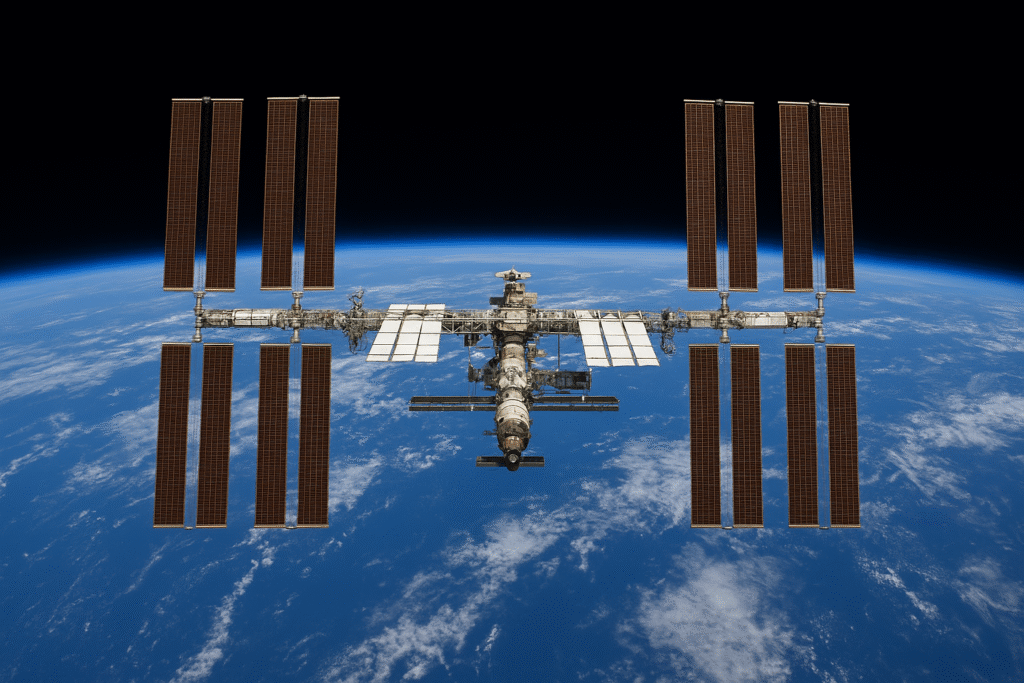
The skies over India are currently displaying a rare and awe-inspiring sight: the International Space Station (ISS), with India’s own Group Captain Sudhanshu Shukla on board, is visible to the naked eye.
For the first time in almost four decades, an Indian astronaut is circling the Earth from the renowned orbital laboratory, and inhabitants across the country have the unique opportunity to see this spectacle with their own eyes. Won’t you take a look at the sky to witness something mind-blowing?
A National Milestone in Orbit: Sudhanshu Shukla’s Journey Into Space
On June 25, 2025, Sudhanshu Shukla became the first Indian astronaut in history to launch into space on Axiom Mission 4 and dock with the ISS a day later. He will be conducting pioneering experiments aboard the station as his fellow Indian citizens watch him live from Earth.
The International Space Station orbits roughly 400 kilometers above Earth and speeds at an astounding 28,000 kilometers per hour, making one full circuit around the planet every 90 minutes. This tremendous velocity, along with the station’s large solar panels that brightly reflect sunlight, makes it one of the brightest things in the sky, visible even after dusk.
When and How You Can Also Spot the ISS in the Sky
The ISS can be seen with the naked eye without the use of a telescope, even though it is so far away. Shortly after sunset or right before sunrise, when the station reflects sunlight but the ground is sufficiently dark for unobstructed vision, are the ideal viewing times. It doesn’t twinkle or make any noise as it swiftly travels across the sky like a brilliant star.
Here are some steps that you should be following to spot the ISS successfully:
- To find specific timings for your area, use tools such as NASA’s “Spot the Station” or the ISS detector.
- These apps offer real-time information about the direction, duration, and altitude of each flyby.
- Head to a spot with an open sky view and minimal light pollution.
- Try focusing on the western horizon, where there are high chances of it to appear first.
Visibility windows are in effect in cities including Delhi, Mumbai, Chennai, Bengaluru, and Kochi from July 6 to July 12, with more passes expected by the end of the month. Depending on your location, each pass might last between 4 and 8 minutes.
Who is Sudhanshu Shukla: India’s Man in Orbit
An accomplished pilot and astronaut in the Indian Air Force’s Gaganyaan program, Group Captain Sudanshu Shukla is actively involved in important scientific initiatives aboard the International Space Station. Future deep-space missions will benefit greatly from his work in biomedical research, microalgae-based renewable energy research, and gravity-free environment simulations.
Using the ISS’s Cupola module, a glass observatory, he recently posted breathtaking views of India, describing it as “grander and more beautiful from space.”. In a heartfelt message, he added, “From this height, there are no borders — only one Earth.”. As with Rakesh Sharma’s well-known 1984 song “Saare Jahaan Se Accha,” his words exude ambition and unity.
A Moment of Space Pride for India
Not only is this a technological triumph, but it is also a national experience. This event is a proud step forward in India’s space exploration journey for more than a billion Indians. India is quickly rising to prominence among spacefaring nations thanks to ISRO’s expanding visibility, partnerships with international organizations, and aspirations for human spaceflight.
What’s even more impressive? The mission reportedly cost less than ₹4 per citizen — making this dream accessible and real for everyone.
Celebrate the Moment: Here’s How
Want to be part of this historic moment? Try these:
- Use time-lapse or long-exposure photography to capture images of the ISS.
- Share your thoughts online by using hashtags such as #IndiaInSpace and #WaveAtShukla.
- Engage children and students in the fun and instructive task of identifying the station.
- With the cameras rolling and the apps ready, throw a neighborhood watch party.