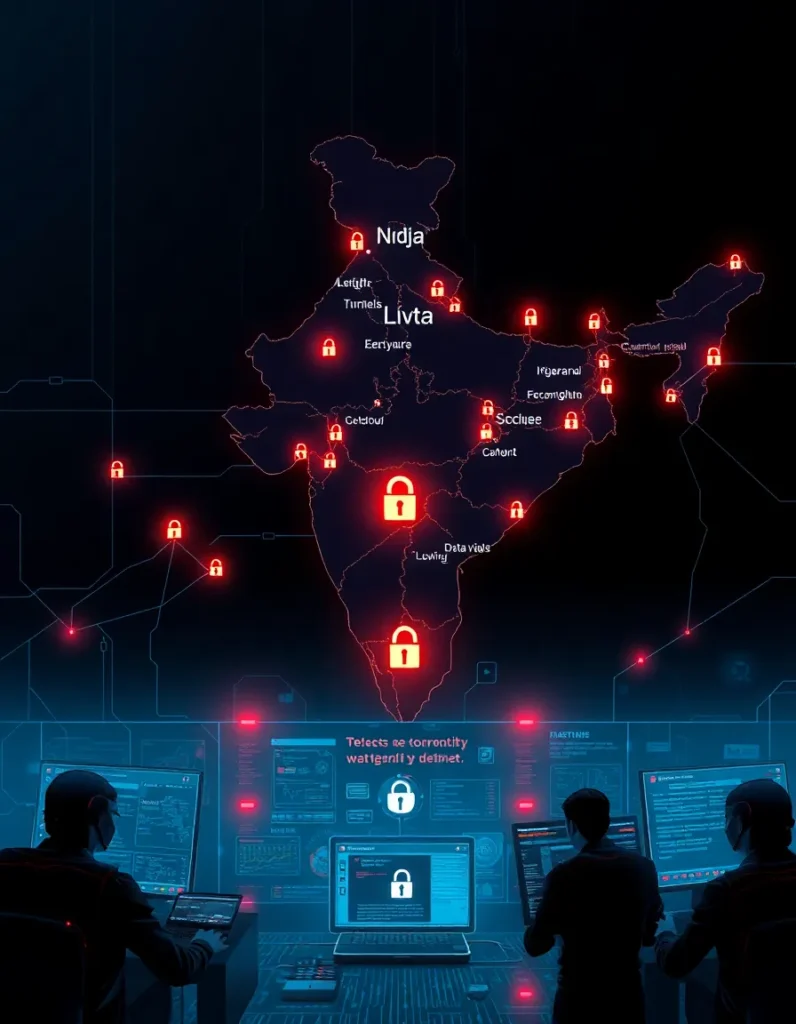
As the world’s second most populous country and home to one of the fastest-growing digital economies, India cybersecurity 2025 started getting top priority within various industries. The country’s approach to cyber threats has changed from being defensive to being proactive due to technological advancements and increased geopolitical awareness. With AI-powered threat detection systems and modernized data protection frameworks, India is building a digital fortress one byte at a time.
A Proactive National Cyber Defense Measurement

India created a comprehensive cyber threat intelligence platform this year, integrating data from the public and commercial sectors in real time. The cutting-edge technology, which implements artificial intelligence (AI) and machine learning systems enabled government agencies working on AI-Powered Cybersecurity India to identify any potential data breaches, analyze patterns, and isolate any kind of possible threat before they become huge and cause any kind of cyber damage.
This change in approach is due to an increase in sophisticated cyberattacks that target public utilities, telecom infrastructures, and banking systems. Realizing how demanding cooperation is needed, India has increased public-private partnerships, effective India digital protocols, uniting government think tanks, telecom behemoths, and cybersecurity startups under a single digital ecosystem.
Zero Trust Architecture (ZTA) is the New Norm
India’s IT ministry has made Zero Trust Architecture (ZTA) most compulsory for each government department and even encouraged its significance to the private enterprises. With this method, no user—internal or external to the network—is automatically trusted. Even in the event that a system is compromised, the breach is immediately contained thanks to encrypted access layers, micro-segmentation, and continuous verification.
Moreover, all critical infrastructure—ranging from transport to power grids—is now onboarded into a Secure Access Service Edge (SASE) model, combining WAN capabilities with comprehensive security as a cloud-delivered service.
AI Watchdogs and Quantum-Proof Cyber Safety
AI is utilized not just for offensive and defensive measures in the digital realm—it has become a crucial element in predictive policing and threat forecasting. Surveillance systems in large urban areas are now equipped with AI, enabling them to identify irregularities autonomously. The National AI Center for Cybersecurity (NACC) and National Cyber Defense India have recently introduced tools designed to simulate attack scenarios in order to improve system resilience.
Meanwhile, quantum-safe encryption methods are being evaluated across various government communication channels. With the emergence of quantum computing, India is already future-proofing its encryption to avoid potential gaps in national security.
Strict Data Privacy Measures
In early 2025, India’s Digital Personal Data Protection Act (DPDPA) was notably enhanced in response to global and local cybersecurity trends India 2025 needs. The updated legislation imposes more stringent regulations regarding data localization, consent management, and the transfer of data across borders. Organizations dealing with sensitive user information are now required to perform quarterly audits and adopt end-to-end encryption as a standard practice.
To ensure compliance, a Data Protection Authority of India (DPAI) has been established, providing independent oversight and quick resolution channels for both companies and citizens.
Conclusive Thoughts
By 2025, India’s strategy for digital security is comprehensive and proactive rather than just reactive. The nation is enhancing its defenses through multiple layers of protection, strengthened regulations, and technology-driven monitoring, transforming its digital weaknesses into strategic advantages.
As the adoption of digital technology increases, India is more determined than ever to safeguard every aspect of its digital landscape.